The mock test
You ride the kind of route an examiner uses, under test conditions, so the nerves get a trial run too.
Our pre-test is a full mock run with one of our instructors. We put you through the real thing, point out what the examiner is actually watching for, and fix the small habits that cost people a pass.
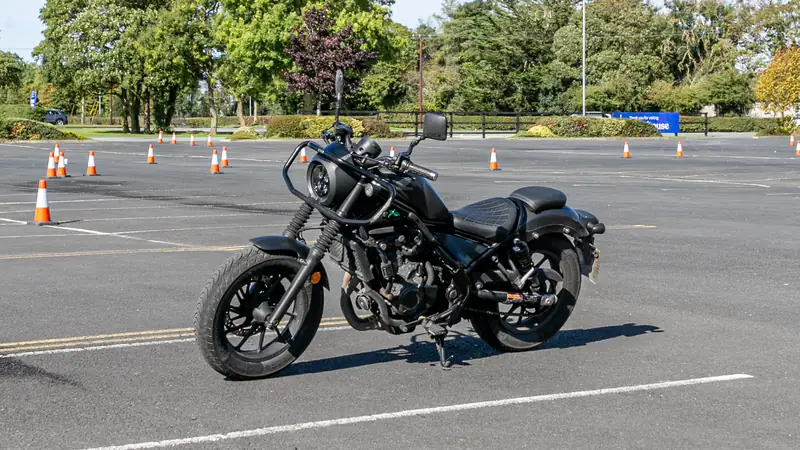
A full mock test on the bike you'll sit your test on, so there are no surprises on the day.
The practical test is run by the RSA, and it comes last, after the theory test, the learner permit and IBT. Our guide covers how to get your motorbike licence in Ireland, step by step. To sit it you need to have held your first learner permit for at least six months and finished your IBT. You apply online at MyRoadSafety.ie. You can book before the six months are up, but you can't sit the test until they are. If no dates are free, you go on a waiting list and the RSA emails you when you can book. The fee is €85, the same for every motorcycle category. Talk to us before you pick a date: we fit your pre-test around it, and if you book first, we may already be full on the days you need.
The motorcycle test takes about 60 minutes. It mixes questions on the Rules of the Road with a practical test of your riding skills and awareness.
At the desk, the tester asks about the Rules of the Road, safety glances, road position and skidding, and you show two hand signals. Then come the checks on the bike: you explain how you'd check three things the tester picks, such as the tyres, brakes or chain, take it off and back on its stand, and walk it at least 4 metres with the engine off. On the road there's a U-turn and at least 50 metres of slow riding at a brisk walking pace, with the tester walking beside you. For A1, A2 and A you also do an emergency braking exercise, slowing from about 55 km/h to 25 km/h without stopping, and an obstacle avoidance exercise at 55 to 60 km/h.
On the day you can ride your own bike, or ours if you did your pre-test with us. If you feel more confident on it, we bring it to the test centre for you. It's insured for you to ride in the test, its papers are in order and it's included in the price of the pre-test. We have bikes for every category, from AM to A, automatics included. In the pre-test we also show you where everything is on the bike, so you know what to point to when the tester asks. If you bring your own, it has to be insured, taxed, roadworthy and within any limits on your learner permit, and you bring its registration certificate showing the power output. For the test you need a helmet, gloves, boots and weather gear, a yellow fluorescent tabard showing L-plates front and back, and a compatible radio earpiece. If you do your pre-test with us, we provide the helmet, gloves, tabard and earpiece, so you only bring your boots and weather gear. If something is missing, the test doesn't go ahead and you lose the fee.
Figures from the RSA (about the test, motorcycle FAQs, booking FAQs, preparing your motorcycle), checked on 29 September 2026. The test length comes from the RSA's motorcycle licence pages, checked on 21 October 2026. The test exercises come from the RSA's standard procedures for driving tests, checked on 20 October 2026.
It's not just another lesson. We run it like the actual test, then talk through everything while it's fresh. A one-hour pre-test is €150 and a two-hour one is €200, with the bike, insurance, gear and instructor included. It can run at Fairyhouse or near the test centre where you've booked your exam, and we'll send you the info and extra material to prepare. We run pre-tests at ten RSA test centres: the seven on the RSA's Dublin list, plus Mullingar, Navan and Dundalk. In Dublin, see our lessons and pre-tests for Dublin riders.
You ride the kind of route an examiner uses, under test conditions, so the nerves get a trial run too.
We tell you exactly what's being marked, from observation to positioning to the manoeuvres, and where marks quietly slip away.
We work on the specific things tripping you up, the small stuff you might not even notice you're doing.
You head to the real test having already done it once, so there are no surprises on the day.
People rarely fail because they can't ride. They fail on observation, on positioning, on a manoeuvre they rushed because they were nervous. A pre-test catches those before they cost you.
Over 2,000 riders have passed their test with us, so we know what the test asks, and we make sure you do too before you sit it.
We only run motorcycle pre-tests, on the same kind of bike you'll sit the test on.
We don't soften it. The closer the mock is to the real thing, the more useful it is.
You'll know where you stand. If you're ready, we'll tell you. If you're not quite there, we'll tell you that too.
It's different rather than harder. You're on the bike on your own, with the tester giving you directions through an earpiece, and there are slow-speed exercises a car test doesn't have, like the U-turn and the slow ride. The RSA says the most common extra reasons for failing the motorbike test are a poor U-turn, weak control at slow speed, not enough rear observation and wrong hand signals. Those are exactly what a pre-test with us works on.
One that counts as a representative bike for your category under the RSA's rules, and within any limits on your learner permit. For an A1 test that's usually a 125cc, since A1 covers bikes up to 125cc. A2 and A tests need bigger bikes that meet the RSA's minimums, set out on its page about preparing your motorcycle. If you did your pre-test with us, you can use one of ours.
One hour is €150 and two hours is €200. Both include our bike, the insurance, the gear and an instructor who takes you through the roads around your test centre.
Whenever suits you. Some riders do it in the hour before their test; others book a few weeks ahead so there's time to practise what comes up.
The tester gives you a statement of the result and goes through where you lost marks. You apply for a new test on MyRoadSafety, pay the €85 fee again and wait for your next invitation to book. The wait is the hard part: the RSA says the wait for a motorbike test is generally 10 to 12 weeks (checked October 2026), and it can be longer at busy centres. Some riders fail the first time, book again and pass, but it pays to apply early and do a pre-test before your first attempt. If you do fail, bring that statement to your next pre-test, so we can work on exactly those points.
There's no wait after IBT itself. What counts is your first learner permit: you need to have held it for at least six months, and your IBT has to be finished. If your permit is already six months old when you complete IBT, you can sit the test as soon as you have a date.
Leave your number and we'll set up a pre-test before your big day.
You'll get a straight answer on anything, prices included. Tell us what you're after, drop your number, and one of the team will ring you to sort it out.